Internal Medicine vs Family Medicine for Medical Students: Key Differences Explained
Posted onKey Takeaways:
- Internal medicine and family medicine differ primarily in patient population, clinical scope, and subspecialization opportunities; internal medicine focuses on adult patients and offers extensive fellowship pathways, while family medicine provides comprehensive care across all ages with an emphasis on continuity and community health.
- Both specialties require three-year residencies but lead to distinct career trajectories: internal medicine often leads to further subspecialty training and diverse practice settings, whereas family medicine prepares graduates for immediate entry into broad primary care roles.
- Hands-on clinical experience, structured mentorship, and a student-centered curriculum, such as those offered at ACSOM, are crucial for making an informed specialty choice and preparing for successful residency placement in either internal medicine or family medicine.
Your specialty choice will shape your entire medical career, from the patients you treat to your training path and lifestyle. Both internal medicine and family medicine offer intellectually rewarding, patient-centered work, but they serve different needs. Internal medicine focuses on comprehensive adult care with strong subspecialty pathways, while family medicine provides cradle-to-grave primary care with deep community connections. The best choice aligns with your clinical interests and career goals.
Quality medical education, experienced faculty mentorship, and hands-on clinical training prepare you for residency success in either path. Understanding internal medicine vs family medicine for medical students starts with knowing what each specialty truly offers.
Internal Medicine vs Family Medicine at a Glance
This internal medicine vs family medicine overview highlights the core differences that shape your training path and daily practice. Here’s how these specialties compare across the most important decision factors:
| Comparison Area | Internal Medicine | Family Medicine
|
|---|---|---|
| Patient Population | Adults only (18+ years) | Across the entire lifespan |
| Training Length | 3-year residency | 3-year residency |
| Subspecialty Options | 20+ fellowship options | Few subspecialty options |
| Primary Practice Settings | Hospitals, clinics, subspecialty offices | Outpatient clinics, community health centers |
| Scope Focus | Deep adult medicine expertise | Broad comprehensive care across the lifespan |
Both specialties offer rewarding patient care with distinct clinical philosophies. Internal medicine emphasizes depth in adult conditions and strong pathways to subspecialization, while family medicine provides comprehensive primary care across all life stages with emphasis on continuity and community health.
ACSOM’s clinical rotations in accredited U.S. hospitals expose you to both specialties during your training, helping you experience these differences firsthand before making your residency choice.
Understanding Internal Medicine and Family Medicine
What Is Internal Medicine?
Internal medicine centers on adult patients from age 18 through older adults. You’ll work in both hospitals and clinics, managing everything from routine checkups to complex medical puzzles. This specialty appeals to students who enjoy diving deep into adult diseases and want multiple subspecialty options after residency. During ACSOM’s clinical rotations, you’ll experience how internal medicine physicians become experts in adult medicine while keeping doors open for fellowship training.
- Adult-only patient population with a focus on complex medical conditions.
- Significant hospital work managing sick patients alongside outpatient clinics.
- Over 20 fellowship options, including cardiology, endocrinology, and critical care.
- Training emphasizes diagnostic reasoning and managing multiple chronic diseases.
What Is Family Medicine?
Family medicine means treating everyone from newborn babies to grandparents, often caring for entire families across generations. You’ll focus on keeping people healthy through preventive services while treating illnesses when they arise. This specialty fits students who want variety in their daily work and enjoy building lasting relationships with patients. Primary care through family medicine lets you be the first point of contact for most health concerns, though research shows that practice scope can vary based on community needs and healthcare systems.
- All ages from birth through end-of-life in one practice.
- Strong preventive focus with wellness visits and health screenings.
- Community-based practice builds long-term patient relationships.
- Broad skills including minor procedures, women’s health, and behavioral health.
When internal medicine and family medicine are explained side by side, the choice often comes down to this: if you want depth in adult medicine and potential subspecialization, internal medicine offers that path. If you value lifespan continuity and community practice, family medicine provides that breadth. Both specialties offer intellectually rewarding work with patients who need your expertise.
Five Key Differences That Shape Your Medical Career
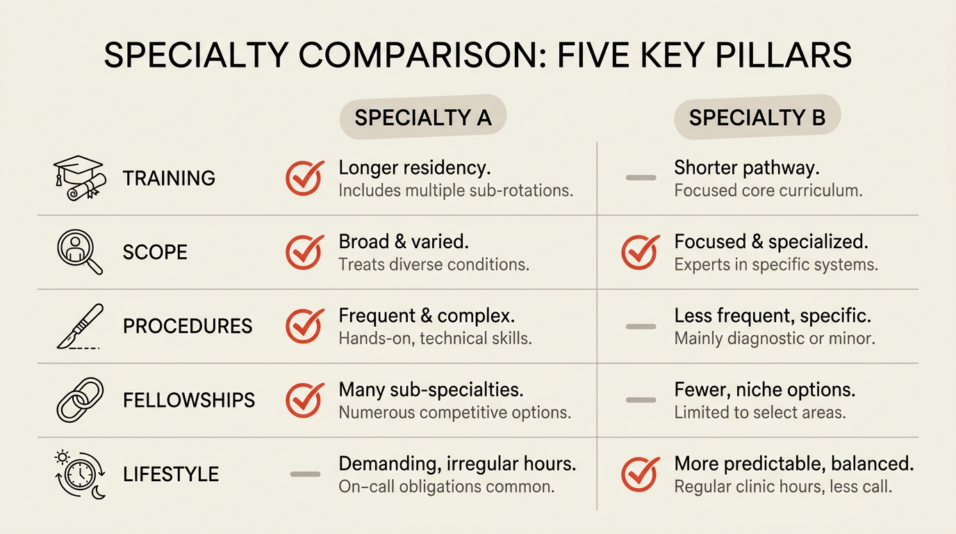
Five important differences reveal the practical realities between internal medicine and family medicine, helping you understand which specialty aligns with your career goals and lifestyle preferences. These internal medicine vs family medicine comparison pillars will guide your decision-making as you prepare for residency applications.
Training Structure and Board Certification
Both specialties require 36 months of specialized training through accredited residency programs, but their focus and outcomes differ significantly. According to the American Board of Internal Medicine, internal medicine emphasizes adult medicine depth with substantial hospital rotations, while the American Board of Family Medicine requires strong continuity clinic experience spanning all age groups.
CSOM’s comprehensive curriculum prepares students for either pathway through early clinical exposure and targeted mentorship.
| Aspect | Internal Medicine | Family Medicine
|
|---|---|---|
| Training Length | 36 months | 36 months |
| Primary Focus | Adult medicine, hospital systems | All ages, community health |
| Board Certification | American Board of Internal Medicine | American Board of Family Medicine |
| Fellowship Preparation | Gateway to 50+ subspecialties | Practice-ready emphasis |
Both offer solid training, but choose based on your subspecialty interests (internal medicine) or comprehensive care goals (family medicine).
Patient Population and Clinical Scope
The patients you’ll care for represent the most significant difference between these specialties. Internal medicine focuses exclusively on adults with complex medical conditions requiring advanced problem-solving skills. Family medicine covers all ages from newborns to seniors, emphasizing preventive care and health maintenance across generations. This scope directly impacts your daily clinical decisions and long-term patient relationships.
| Aspect | Internal Medicine | Family Medicine
|
|---|---|---|
| Age Range | Adults 18+ | All ages |
| Clinical Focus | Complex adult diseases | Acute and chronic care |
| Prevention Role | Adult screening, chronic disease | Comprehensive wellness |
| Procedures | Limited outpatient | Minor procedures, some obstetrics |
Practice Settings and Career Flexibility
Your work environment and daily schedule vary dramatically between these specialties. Internal medicine offers diverse settings from hospital medicine to specialty clinics, with many physicians pursuing additional fellowship training. Family medicine doctors typically work in outpatient clinics with predictable schedules, though some add hospital privileges or urgent care shifts. The clinical rotations at ACSOM expose students to both hospital-based and community practice models, helping you experience these different environments firsthand.
| Aspect | Internal Medicine | Family Medicine
|
|---|---|---|
| Primary Settings | Hospitals, specialty clinics | Outpatient clinics, community centers |
| Hospital Work | High (hospitalist tracks common) | Variable (some maintain privileges) |
| Call Schedule | Frequent, especially in hospitals | Less frequent, mainly obstetrics |
| Location Options | Urban/suburban focus | Excellent rural opportunities |
Subspecialization and Fellowship Options
The pathway after residency differs substantially between these specialties. Most internal medicine residents pursue fellowships, extending their education by one to three years but significantly expanding career options in areas like cardiology, gastroenterology, or critical care. Family medicine graduates typically enter practice immediately, though some pursue focused training in sports medicine, geriatrics, or obstetrics.
| Aspect | Internal Medicine | Family Medicine
|
|---|---|---|
| Fellowship Rate | 70-80% pursue additional training | 10-15% pursue fellowships |
| Specialty Options | 50+ recognized subspecialties | 8 fellowship options |
| Additional Training | 1-3 years post-residency | 1 year if chosen |
| Practice Focus | Highly specialized populations | Generalist with optional skills |
Lifestyle and Long-term Satisfaction
Work-life balance considerations often influence specialty choice, and these fields offer different lifestyle patterns. Family medicine generally provides more predictable schedules with standard clinic hours, though obstetrics coverage can require night and weekend calls. Internal medicine lifestyle varies widely depending on your chosen path, from hospitalist shifts with defined schedules to subspecialty practices with more traditional hours. The experienced faculty mentorship at ACSOM helps students understand these lifestyle realities through direct clinical exposure and career guidance.
| Aspect | Internal Medicine | Family Medicine
|
|---|---|---|
| Schedule Type | Variable by specialty/setting | Generally predictable |
| Call Frequency | High in hospitals, varies elsewhere | Moderate, mainly obstetrics |
| Patient Relationships | Episode-focused or specialized | Long-term, multi-generational |
| Income Range | Wide range, higher in subspecialties | Stable primary care compensation |
What to Look for Before You Choose
Making the right specialty choice requires honest self-reflection and real-world exposure. Rather than relying on assumptions, successful students use structured approaches to evaluate fit and gather meaningful clinical experiences that inform their decision.
- Create a weighted decision matrix – Score patient population interest (17%), career goals and subspecialization appetite (62%), and lifestyle priorities (21%) to quantify your preferences objectively.
- Shadow both hospitalist teams and outpatient continuity clinics – Compare the pace, teamwork dynamics, and patient relationships across inpatient and ambulatory settings to see daily realities firsthand.
- Connect with practicing physicians in both fields – Seek mentorship from faculty who understand how to choose internal medicine or family medicine based on your specific interests and career timeline.
- Complete targeted clinical rotations early – Use structured clinical experiences during your third and fourth years to test assumptions about patient care and work environment.
- Apply your scoring results strategically – If internal medicine scores 76 or higher in your matrix, prioritize IM programs; if family medicine leads decisively, seek broad primary care exposure and community-focused mentors.
The right preparation and guidance make this choice clearer and more confident.
Built for Your Success
Choosing between internal medicine and family medicine requires more than just understanding the specialties. You need a medical education that prepares you to excel in either path while building the clinical confidence and exam readiness that North American residency programs demand.
ACSOM’s student-focused approach means you receive personalized guidance from day one, helping you explore both specialties through hands-on experience and targeted mentorship that clarifies your direction.
Here’s how ACSOM sets you apart:
- Rigorous, U.S.-modeled curriculum with small cohorts: Our flipped-classroom model and case-based learning mirror the clinical reasoning you’ll use in internal medicine or family medicine, while small class sizes ensure individualized attention that large programs cannot provide.
- Clinical rotations in accredited hospitals: Complete rotations alongside residents at ACGME-accredited U.S. teaching hospitals, gaining the diverse patient exposure and procedural experience that strengthens applications for both IM and FM residencies.
- Faculty mentorship that matters: Our North American-trained faculty provide targeted guidance on USMLE preparation, research opportunities, and application strategy, helping you meet ECFMG certification requirements while building competitive residency profiles.
- Proven pathway to residency: ACSOM graduates successfully match into internal medicine and family medicine programs across the U.S. and Canada, supported by comprehensive exam preparation and strategic clinical experiences.
Research shows that flipped-classroom pedagogy enhances clinical reasoning skills needed for both specialties. Ready to build your foundation for internal medicine or family medicine success? Apply now and start your journey with personalized mentorship and comprehensive clinical training.
Your Medical Future Starts Here
Whether you choose internal medicine or family medicine, both paths offer meaningful careers serving patients and communities. Internal medicine provides depth in adult care with extensive subspecialty opportunities, while family medicine delivers comprehensive, lasting patient relationships across all ages. The right choice aligns with your interests in patient populations, practice settings, and long-term career vision, as outlined by the American College of Physicians.
To make this decision confidently, your path forward involves mapping these insights to your personal goals and gaining hands-on clinical experience. ACSOM’s accredited curriculum provides the foundation you need: personalized mentorship from experienced faculty, practical training in U.S. teaching hospitals, and the rigorous preparation that leads to successful residency placement in either specialty. Our student-centered approach means you’ll have the guidance and bedside learning opportunities to make an informed decision while building a competitive application.
Ready to begin your journey toward your medical career? Apply now to join a community of aspiring physicians at ACSOM and access the mentorship that will guide you toward internal medicine or family medicine success.
Internal Medicine vs Family Medicine: FAQs
Which specialty offers better work-life balance?
Family medicine often provides more predictable clinic schedules with regular office hours, making it easier to plan personal time. Internal medicine varies significantly depending on your chosen path, with hospitalists working demanding schedules but having time off between rotations, while outpatient internists typically maintain more regular hours, and subspecialists face different demands based on their fellowship choice.
How do the residency programs compare?
Both are three-year residency programs as outlined by the American Board of Internal Medicine, but they prepare you differently for practice. Internal medicine residencies commonly lead to fellowship training in subspecialties, while family medicine graduates are immediately ready for comprehensive primary care across all age groups.
What career opportunities exist after training?
Internal medicine opens doors to numerous fellowship options and hospital-based roles, from cardiology to infectious diseases. Family medicine supports primary care leadership, office-based procedures, and community health innovation, with opportunities to shape population health in your community and lead healthcare transformation initiatives.
What are the main differences for medical students?
The biggest contrasts lie in patient population focus, scope across the lifespan, and subspecialty availability. As the American Academy of Family Physicians explains, family medicine covers cradle-to-grave care, while internal medicine concentrates on adult patients with deeper medical complexity and diagnostic challenges.
How should I build a competitive application?
Seek mentorship early, excel on board exams, and prioritize relevant rotations during your clinical training. ACSOM’s personalized approach and U.S. hospital partnerships provide the foundation you need for either specialty path, with faculty guidance tailored to your chosen direction.
Whichever path resonates with your interests, ACSOM’s comprehensive curriculum and dedicated mentorship prepare you to make this choice confidently and succeed in your chosen specialty.
