ACSOM vs Ross University Tuition in 2026: Cost and Value
Posted onKey Takeaways:
- The real difference in this comparison is not just tuition on paper; ACSOM’s non-profit model pairs a competitive baseline price with a student-centered MD pathway built to support residency, licensure, and long-term return on investment.
- ACSOM can change the net cost equation more than a sticker-price comparison suggests because every applicant receives automatic consideration for institutional merit scholarships, which may continue into clinical training and may be combined with external funding, depending on award terms.
- A useful tuition comparison has to include total cost of attendance, living expenses, and clinical-phase costs, and ACSOM makes that planning easier with transparent cost data, predictable housing figures, and a North American-aligned program structure.
Ross University is operated by Adtalem Global Education, a publicly traded company. ACSOM is a non-profit. Most students start the tuition comparison by searching for a number, but that governance difference is where the comparison actually begins. It determines who sets the tuition, how generously scholarships get funded, and where resources flow when tradeoffs have to be made. When you sit down to compare ACSOM vs Ross University tuition, the headline figure is just the starting point. What actually shapes your debt load and your career trajectory is the institutional model behind it.
The comparison worth making looks at scholarships, total cost of attendance, program structure, and the pathway each school offers toward residency and licensure. American Canadian School of Medicine (ACSOM) approaches that equation as a non-profit institution, pairing competitive tuition with merit-based scholarships and a North American-aligned MD pathway built around student outcomes.
How ACSOM Tuition Compares to Ross
When prospective students ask how ACSOM tuition compares to Ross University, the instinct is to line up the numbers. That matters. But the table below is not only a price comparison. It is a comparison of two funding models, and the difference between them shows up not just in what you pay, but in what your school does with it.
| Factor | ACSOM | Ross University
|
|---|---|---|
| Tuition Positioning | Published tuition and fees of USD 50,000 per year in Years 1 and 2 and USD 57,000 per year in Years 3 and 4 | See Ross University’s published tuition and fees for current figures |
| Institutional Model | Non-profit; surplus reinvested into student resources and outcomes | For-profit; operated by Adtalem Global Education, a publicly traded company |
| Scholarship Availability | Merit-based scholarships available; designed to reduce net cost and improve access | Scholarships available; confirm eligibility terms and award amounts directly with Ross |
| Clinical Training Alignment | Clinical training details on the ACSOM Clinical Rotations page; curriculum modeled on U.S. and Canadian standards | Review Ross University’s published clinical rotation information |
| Class Size and Mentorship | Small cohorts with personalized faculty mentorship | Confirm current class sizes and mentorship structure directly with Ross |
| What This Means for You | Published tuition plus automatic scholarship consideration shapes your net cost; a non-profit model keeps incentives aligned with student success | Published tuition is the starting point; applicants should verify net cost after any aid and factor in the for-profit structure when weighing long-term support |
ACSOM frames affordability as a mission commitment, not a marketing lever. Because the school operates as a non-profit, the goal is to keep tuition accessible while reinvesting resources into the faculty, curriculum, and clinical training that shape whether graduates actually match into residency and earn licensure.
Scholarships and Financial Aid Change the Real Price
Published tuition is the number everyone searches for first, but it is rarely the number that ends up mattering most. What you actually pay depends on scholarships, how they are applied, and whether they hold through the full program. That gap between sticker price and net cost is where a real tuition comparison has to happen.
At ACSOM, every applicant is automatically considered for merit-based scholarships without a separate application. Eligibility is evaluated on a holistic basis, meaning academic performance, leadership, and community service all factor in. Depending on award terms, scholarships may continue through clinical rotations, so confirm with the Financial Aid office how your award applies across the full MD program, not just the first semester. For students on the MD Direct pathway, scholarship consideration applies without an MCAT requirement.
Whichever schools are on your list, these are the questions worth asking before you commit:
- Confirm who qualifies. Ask whether scholarship eligibility requires a separate process or is built into the standard application review. At ACSOM, holistic merit consideration is automatic for all applicants.
- Understand how awards are applied. Find out if scholarships reduce tuition directly each semester or arrive as one-time grants. Where offered, consistent semester-level reductions make budgeting far more manageable.
- Ask about renewability. A scholarship that disappears after year one offers limited financial relief. At ACSOM, ask the Financial Aid office whether and how your award may carry into the clinical years.
- Check predictability. A financing plan that shifts mid-program forces students to scramble. Knowing the terms upfront, including refund policies and payment schedules, is part of what makes a plan reliable.
- Look for stacking options. ACSOM scholarships may be combined with external funding sources, subject to award terms, including support through the ACSOM Foundation, which extends access further for students who need it.
ACSOM’s scholarship model reflects its non-profit structure. The goal is to lower barriers for qualified students, not to use aid as a short-term recruiting tool. When you factor in that ACSOM reports tuition approximately 20% lower than other medical schools in the region, merit awards reduce an already competitive baseline, which can meaningfully change the debt picture by graduation.
Total Cost of Attendance Goes Beyond Tuition
Total cost of attendance is what actually determines your debt load. A fair comparison between any two schools requires examining every budget category across both the preclinical and clinical phases of the program.
Build the Full Picture Before You Compare
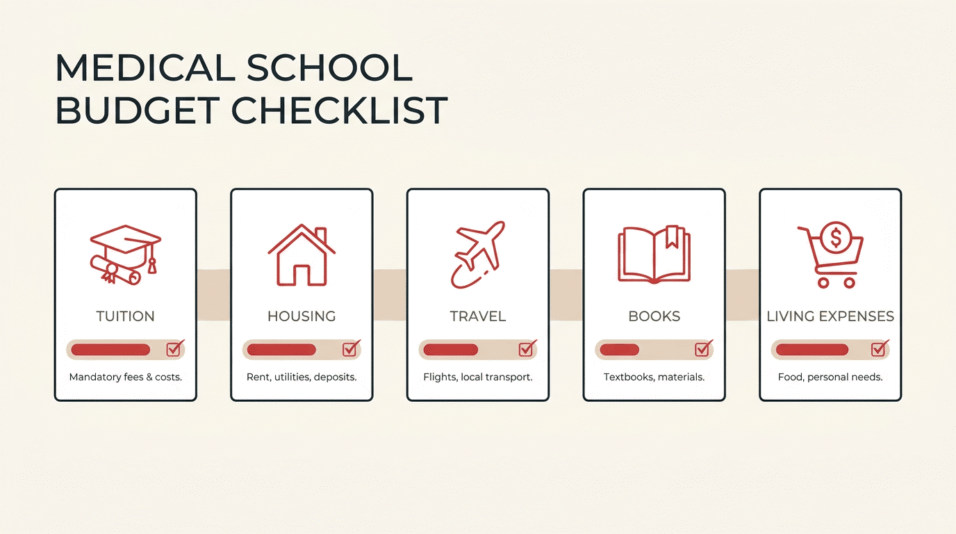
A complete budget includes tuition, mandatory fees, housing, travel, textbooks, health insurance, and daily living costs. According to ACSOM’s published cost of attendance, students should account for all of these categories across both the preclinical and clinical phases of the program. Skipping any one category leads to an underestimate that can quietly grow into a significant financing gap by year three.
Living Costs in Dominica Are More Predictable Than You Might Expect
ACSOM’s 2026 cost-of-living data places monthly living expenses between USD 1,525 and 1,900, or roughly USD 18,300 to 22,800 per year. Students in ACSOM’s Marina Vista housing pay USD 600 per month in rent plus a USD 100 fee that covers housekeeping and water, with high-speed internet and an on-site generator included; electricity is paid separately. That level of transparency lets you plan with real numbers rather than rough guesses.
Clinical Phase Costs Deserve Their Own Line Item
The clinical years introduce a different budget profile. Travel, licensing fees, and rotation-related expenses shift meaningfully when students move from campus into clinical rotations. ACSOM’s estimated cost of attendance, for example, budgets USD 18,300 per year for living expenses in Years 1 and 2 and USD 28,800 per year in Years 3 and 4. When comparing ACSOM and Ross, ask both schools for a year-by-year cost breakdown that includes the clinical phase, not just the preclinical years. AAMC tuition data offers a useful benchmark for understanding where Caribbean school costs land relative to U.S. programs, but those figures rarely capture the full picture either.
Program Structure Shapes Budgeting Predictability
A school’s structure affects more than academics. Smaller cohorts, clear clinical rotation timelines, and transparent fee schedules make multi-year financial planning more reliable. When costs shift unexpectedly, usually due to placement delays or unannounced fee changes, students bear both the financial and academic consequences. A school that publishes detailed, category-level cost data signals how it prioritizes student planning.
FAQ: ACSOM vs Ross University Tuition
Choosing between two Caribbean medical schools involves more than comparing two numbers on a webpage. The questions below address what most applicants want to know before committing: which costs shift after aid, what gets left out of the sticker price, and how each school’s model affects long-term return on investment.
How does ACSOM tuition compare to Ross when scholarships are included?
ACSOM publishes tuition and fees of USD 50,000 per year in Years 1 and 2 and USD 57,000 per year in Years 3 and 4, and all applicants receive automatic consideration for merit-based scholarships with no separate application. Depending on award terms, scholarships may continue into the clinical phase, which can meaningfully lower net cost over a full program. For Ross, compare its published tuition against any aid offered to you in writing.
What costs besides tuition should students compare between ACSOM and Ross University?
Published tuition is only one piece of the total cost of attendance. Both schools carry additional fees, housing, travel, health insurance, and living expenses that can add tens of thousands of dollars per year. The AAMC’s physician education debt report consistently shows that non-tuition costs are a major driver of total debt at graduation.
Does ACSOM offer any financing options beyond scholarships?
Yes. ACSOM offers a school-sponsored private loan for eligible U.S. and Canadian students, in addition to merit-based scholarships. Dominican citizens may qualify for full tuition coverage. You can review the complete breakdown of aid options on the ACSOM tuition and financial aid page.
Which school offers better long-term return on investment?
ROI depends on three things: total debt at graduation, residency match success, and time to licensure. ACSOM’s non-profit structure and automatic scholarship consideration are designed to reduce debt, and the school holds full IAAR and provisional ACCM accreditation, both recognized by the WFME. A school’s model matters as much as its price when projecting long-term financial outcomes.
Can scholarship awards be combined with external financial aid?
ACSOM scholarships may be combined with external funding sources, subject to award terms and standard eligibility rules. This gives students more flexibility to build a financing plan that covers the full cost of attendance. Details on ACSOM scholarship eligibility and application steps are available for students ready to plan their funding strategy.
Compare Net Cost, Pathway, and Long-Term Value
Net cost, program structure, and residency readiness are what this comparison ultimately turns on. At ACSOM, merit scholarship consideration is built into the standard admissions review and applied automatically, with no separate application. That structure reflects a non-profit’s core priority: to reduce the real cost for qualified students, not just the advertised one.
The logic is worth following to its conclusion. A school without shareholders can set tuition, fund merit awards, and invest in clinical training without balancing those decisions against a quarterly earnings report. When you factor in long-term debt relief options like those outlined by the AAMC, a well-structured, affordable program compounds in value over a career in ways a lower sticker price alone never could.
Start with the numbers that apply to you. Request information from ACSOM to see what your net cost could look like and build a plan grounded in real figures.
